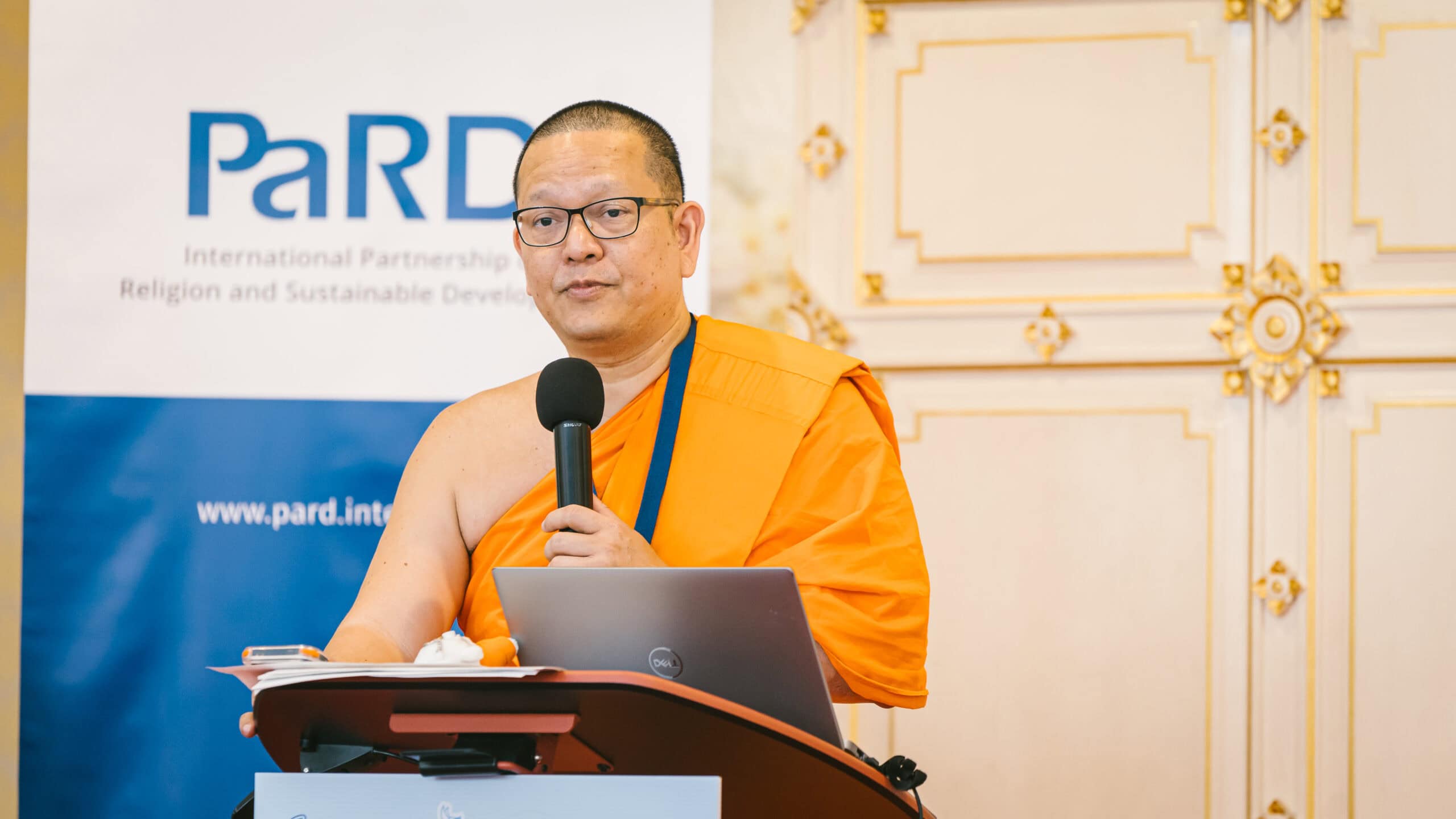
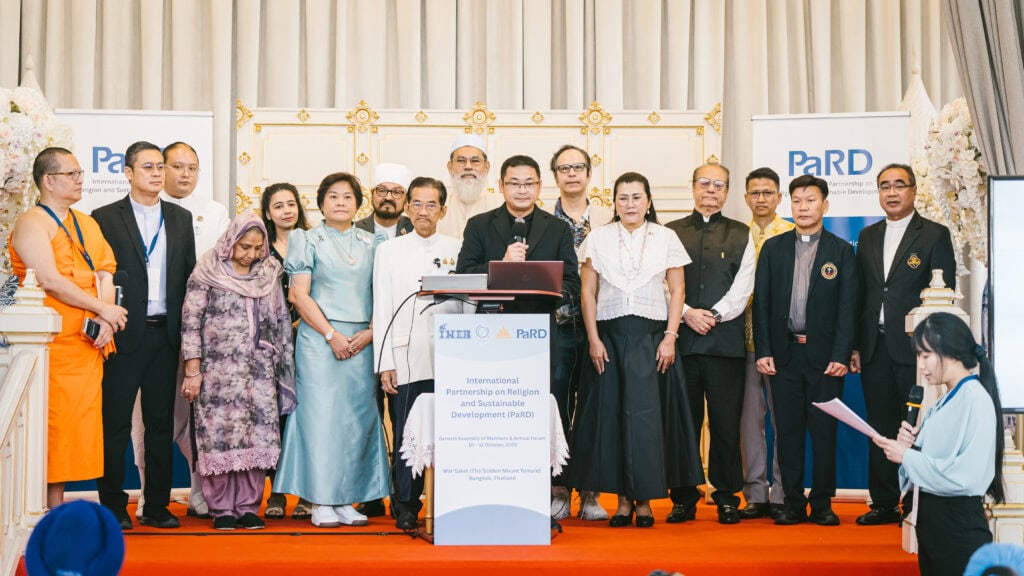
In his welcome remarks, Mr. Pojanat Panyasilp reflected on the role of religion in sustainable development, highlighting how shared values, community networks, and cooperation can drive change. He was joined by representatives of several faith traditions in Thailand, who were introduced at the end of his speech.
May I first pay my respects to Venerable Napan Santibhaddo and extend my greetings to Mr. Krushwant Singh.
Distinguished Religious Leaders, Representatives of Religious Organisations, Representatives of Government Agencies, International Organisations, and all participants,
I am Mr. Pojanat Panyasilp, Deputy Director-General of the Department of Religious Affairs, Acting Director-General of the Department of Religious Affairs.
I feel greatly honoured and delighted to have the opportunity to participate in today’s interreligious meeting of the International Partnership on Religion and Sustainable Development, or PaRD.
Today’s meeting is an important platform because it provides an opportunity for representatives from different religions and sectors to meet, exchange experiences, and think together about how we can use the power of religion and faith to support sustainable social development in various dimensions.
When we talk about “sustainable development” (Sustainable Development Goals), we may think of the economy, the environment, technology, or infrastructure development. But in reality, sustainability does not mean only preserving resources for future generations. It also means developing quality individuals, building a responsible society, and creating a world where people can live together peacefully and respect one another.
In this regard, I believe that religion plays a very important role. This is because religion is not only a source of spiritual support, but also plays an important role in shaping people’s thoughts, values, and behaviours.
The teachings of different religions share common values that can support sustainable development, including compassion, sharing, sacrifice, responsibility, non-harm, caring for nature, and peaceful coexistence.
Religion can therefore contribute to sustainable development in several dimensions, including:
- Human development
Religion can promote morality, ethics, and care for those in need.
- Environment
Religious teachings on non-harm and moderation can help create awareness of the importance of caring for nature.
- Peace
Religion can serve as a bridge connecting people who have differences and promote understanding between religions.
- Cooperation
Religious organisations and places of worship have networks at the community level and can translate ideas and policies into concrete actions.
Thailand itself has continuously gained experience in this area. Many places of worship do not serve only as places for religious activities, but also as community centres. They are places for learning, helping those in difficulty, promoting morality, and building relationships among people in society. These examples demonstrate that religion can be a social force that helps support sustainable development.
However, sustainable development cannot be achieved by any single religion or any single organisation alone. We need cooperation. Cooperation among followers of all religions, between the government and civil society, as well as cooperation with international organisations and various sectors.
Therefore, I believe that today’s PaRD platform is extremely important. Because it is a space where we can exchange experiences from different religions and different countries, and find common ground that can lead to working together for the benefit of society and humanity.
For Thailand, participation in this kind of platform is also an important opportunity to share Thailand’s experiences in religion and coexistence among diverse groups of people with other countries. At the same time, it is an opportunity to learn new approaches that can be used to develop work in religious affairs in accordance with the current global context.
Finally, I would like to leave you with this thought. Sustainable development may begin with policies at the global level. But it can truly happen when changes take place at the individual and community levels. And religion can play an important role in creating those changes. Because religion can create understanding, values, and inspiration that encourage people to choose to do what is good for themselves, for others, and for society. If we can concretely integrate the power of religion, morality, and interreligious cooperation with the Sustainable Development Goals, I believe that we can work together to build a society that is peaceful, has mutual understanding, respects differences, and leaves no one behind.
On this occasion, I would like to thank all Venerable Monks, as well as religious organisations from all five religions, government agencies, and everyone involved in organising this meeting.
May today’s meeting be a starting point for exchanging knowledge and learning from one another, and lead to stronger interreligious cooperation. So that we can work together to build a peaceful society and continue advancing sustainable development.
Thank you.