Why faith, wisdom and development expertise matter more than ever in shaping a future of dignity through collective action.
Welcome to Bangkok: Religion matters – Faith in action for the next decade!
ยินดีต้อนรับสู่กรุงเทพฯ
It is a great pleasure to welcome you all to the PaRD Annual Forum 2026, “Beyond Partnership: Faith in Action for the Next Decade”. I am delighted that we have come together here in Thailand, bringing people from different countries, religious and spiritual traditions, institutions and backgrounds into one space.
When wisdom becomes action
Let me begin with a story from Thailand: In the early 1990s, a Buddhist monk named Phra Subin Paneeto founded the Sajja Sasom Sab network to help impoverished rural villagers escape the cycle of exploitative lending. The idea was simple but powerful: people pool small monthly savings, which are then used to provide affordable loans for essential needs such as healthcare and education. Rather than relying on conventional collateral, the system draws on Buddhist principles of karma and mutual community guarantees. The result is a community-based microfinance model with virtually no loan defaults.
This is a remarkable example of what can happen when spiritual wisdom becomes practical action and when trust, shared responsibility and community solidarity are translated into an institutional response to people’s needs. Why have I chosen to open our Forum with this story? Its significance will become clear as we explore the days ahead.
We all go through crises. They are an existential experience that binds us together, regardless of where we come from, what we believe or how we live. A crisis can shake the foundations on which we have built our lives and institutions. But it can also open a space for learning, for changing course, for growing and for discovering a resilience we may not have known we had. A crisis confronts us with a choice about what we carry forward, what we leave behind and what we are ready to create anew.
Around nine out of ten people in the world affiliate with a religion. Religion is a powerful source, and it is ambivalent in many ways. No doubt, religion aims to unite, yet it can also be misused to divide and exclude.
My own way of life, inspired by a holistic spiritual wisdom tradition, has at times been a reason for people to discriminate against or even insult me. Yet, at the same time, nothing else has given me so much wisdom, resilience and hope. Religion not only mattered to me; it helped me endure difficult circumstances and imagine a different future. In the challenging situation in which PaRD, the International Partnership on Religion and Sustainable Development, finds itself today, I feel that these very characteristics are needed.
We are living through a period of profound uncertainty. Wars and displacement, climate change and environmental destruction, inequality, hate and polarisation, human rights violations and shrinking civic space are placing immense pressure on people, especially civil society. Barriers between people, communities and institutions are becoming higher and more difficult to cross, even as our shared blue planet needs cooperation more than ever to flourish.
This is precisely why religion matters in global affairs.
Consider Buddhist monks in southern Thailand who support people affected by conflict while helping to defend their human rights. Think of religious leaders in Nigeria working to prevent and respond to gender-based violence and female genital mutilation. Consider young women across Egypt, Kenya, Palestine and South Sudan challenging old norms and creating more space for girls and women to live with dignity and exercise their rights. Or volunteers helping displaced children carry the psychological burden of conflict, loss and uncertainty through faith-sensitive approaches. And think of a spiritual community in India transforming waste into energy and fertiliser.
These are not isolated examples of religion as an abstract idea. They show people putting their values into practice, responding to concrete challenges and contributing to the well-being of others. Religion is not simply an abstract category that can be studied or politically instrumentalised. It is a source of action, trusted relationships, ethical commitment and community engagement, often carried by people who give their time as volunteers. Religious and spiritual actors accompany vulnerable people through moments of suffering, create spaces for dialogue and healing, and build bridges where mistrust has taken root. Religious and spiritual communities have been caring for the sick, educating young people, supporting people in humanitarian crises, feeding those in need, mediating conflicts and protecting the vulnerable for generations. The 2030 Agenda did not create these contributions. It created a framework to recognise, connect and strengthen the role of religious actors in global affairs.
Bridging divides, shaping our future together
Saying that religion matters is therefore not enough. The more important questions are: How does religion matter? Where does it make a difference? What can we learn from these experiences? Making these contributions visible is not about giving religion a privileged place. It is about recognising realities and creating spaces in which religious, spiritual and secular perspectives can meet without either side having to give up its own legitimacy.
This has been at the heart of PaRD. Ten years of PaRD have meant working between religious and secular worlds and across continents, bringing together government entities, multilateral organisations, academic institutions, and religious and other civil society actors in a multi-stakeholder partnership. PaRD has demonstrated that the most meaningful partnerships are rarely created simply because institutions sign agreements. True partnerships emerge when people meet each other, listen, build trust, discover new perspectives and ways of collaborating, and achieve results for the common good that they could not have achieved alone. PaRD itself is a testament to the power of such collective commitment.
I would like to express my sincere gratitude to the German Federal Ministry for Economic Cooperation and Development (BMZ) for its sustained support of PaRD. I also warmly thank all PaRD members and partners who have contributed to the partnership’s establishment and expansion, not only through their financial support but also through substantial in-kind contributions. Their dedication, expertise, time and trust have been essential to building PaRD.
At a time when the world is becoming more fragmented, we need these kinds of spaces where people can encounter one another respectfully across the boundaries that increasingly separate us. We need them locally, where trust is built between neighbours and communities, and globally, where decisions taken in one place can affect the lives of millions elsewhere. We also need them because the way we respond to global challenges is changing. Unilateral approaches are gaining ground. But complex problems cannot be solved by a single people or nation. Weapons and technology, particularly algorithms and so-called artificial intelligence, cannot solve the existential and ethical problems we face. Technology alone cannot tell us whether a particular path is worth taking, what kind of society we want to live in, or how power and responsibility are to be exercised.
We need ethical reflection and wisdom alongside technical innovation. We need spaces in which people can ponder not only what we can do, but whether we should do it and how we can contribute to holistic well-being. Religious and spiritual traditions and actors have an important contribution to make here. They carry centuries of reflection on human dignity, responsibility, compassion, justice, interconnectedness, and the relationship between human beings, nature and the universe.
Crises do not determine our future. The response to the crisis does.
And this brings me back to the story of Phra Subin Paneeto and the Sajja Sasom Sab network. What we see in this example is not simply a microfinance initiative. It is an illustration of how religious values, community trust and locally available resources can become a practical response to economic vulnerability. It also raises a question that goes beyond Thailand: How can we recognise and connect the resources, knowledge and commitment that religious communities already bring to development? This is one of the questions we will explore during this Annual Forum, particularly in our cooperation with the World Bank Group on faith-based resources for development financing. Religious giving, investments and institutional resources can complement established development financing. The challenge is to build meaningful cooperation while respecting the values, priorities and independence of religious organisations and avoiding their instrumentalisation.
Our discussions will also take us into other important areas. We will explore how knowledge about religion and global affairs can be preserved, shared and made accessible, particularly when institutions change or come to an end. We will discuss the opportunities and limitations of digital tools and artificial intelligence, including how to retain context, evidence quality and the human relationships that make knowledge meaningful. We will also look at food security and the contributions religious and spiritual communities can make to more sustainable and resilient food systems. These topics are connected. Whether we talk about knowledge, financing or food security, we are ultimately asking how we can bring together different forms of expertise, experience and resources to address shared challenges. We need innovation, but we also need wisdom. We need data, but we also need context. We need institutions, but above all, we need people and relationships.
This brings us to a decisive moment for PaRD itself. From 2027 onwards, the partnership’s funding structure will change decisively. This marks the end of one chapter and the beginning of a new one. For PaRD, this is an opportunity to ask not simply how we preserve what has been built, but what kind of partnership we want to create for the years ahead. PaRD is reaching the end of one chapter precisely as the world needs the kind of bridge-building that PaRD was created to enable. The question is therefore not whether PaRD is needed or can continue. The more important question is what PaRD can become in a changed world where more members, institutions and partners take ownership of its future.
That transformation cannot be achieved by individual members or the PaRD Secretariat alone. It requires the commitment and ownership of all members. It also requires support from beyond the PaRD family, from those who see the value of connecting religious and secular actors to strengthen dignity, peace, social cohesion and well-being. Our experiences over the past ten years offer reasons for hope. They show that change does not depend only on large organisations or funding. It begins with people who have the courage to do the right thing with the right people when it is needed. What becomes possible when people bring their convictions, relationships, knowledge and resources to the common good is precisely what we should explore together.
The world needs fewer barriers between religious and secular actors, between governments and communities, and between global institutions and the people they seek to serve. The world needs bridges and bridgebuilders. We need them between generations, between traditions and between people who do not always speak the same language. And we need people willing not only to build these bridges, but to cross them.
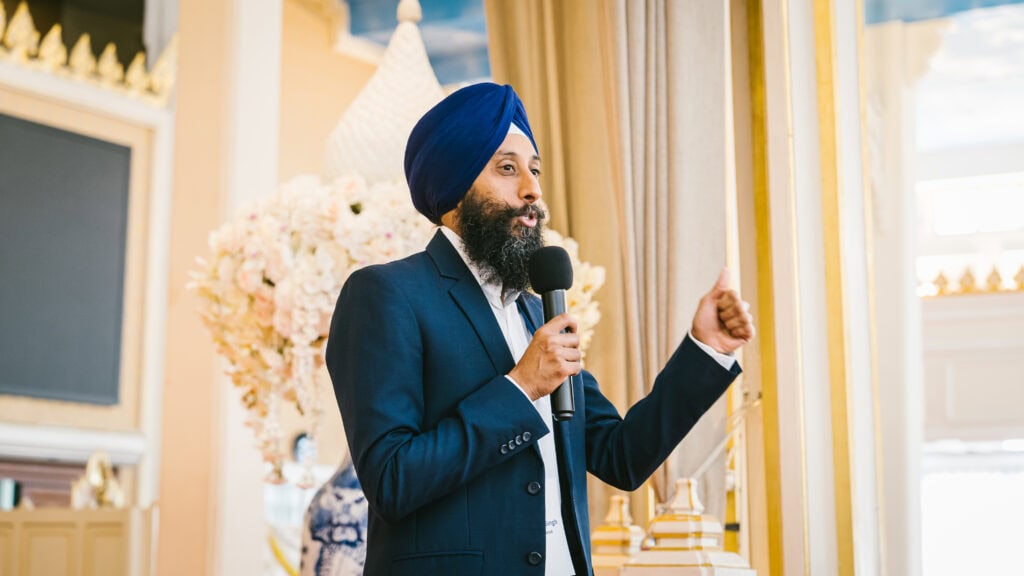
ਯਾ ਜੁਗ ਮਹਿ ਏਕਹਿ ਕਉ ਆਇਆ ॥ ਜਨਮਤ ਮੋਹਿਓ ਮੋਹਨੀ ਮਾਇਆ ॥
Guru Granth Sahib, 251, M.5
The wisdom of Sikhi reminds us that we have come into this world, this diaspora of ephemerality, to heal and unite and to return home to our common spiritual homeland. This sounds like a fitting guiding principle for our future endeavours – for ourselves, for PaRD and for all global affairs.
Before I close, I would like to express my heartfelt thanks to Wat Saket and Venerable Napan for welcoming us and making this gathering possible in such a special place. My sincere thanks also go to all PaRD members and partners who have travelled here and contributed to making this Annual Forum a reality. I would also like to thank Cara Santos Pianesi from the World Bank Group for her cooperation regarding the sessions on faith financing. And, of course, thank you to our photographer, caterer, drivers, the volunteers here at the temple and everyone working behind the scenes. Many contributions remain unseen, but without them, a gathering like this would not be possible. Finally, I express my gratitude to the entire PaRD Secretariat team for their excellent work!
I wish all of us inspiring conversations, new perspectives, meaningful encounters and, above all, the courage to turn our discussions into action. Let us use these days not only to reflect on what we have achieved, but also to imagine what we can create together for the next decade.
ขอบคุณมากครับ
Thank you very much!