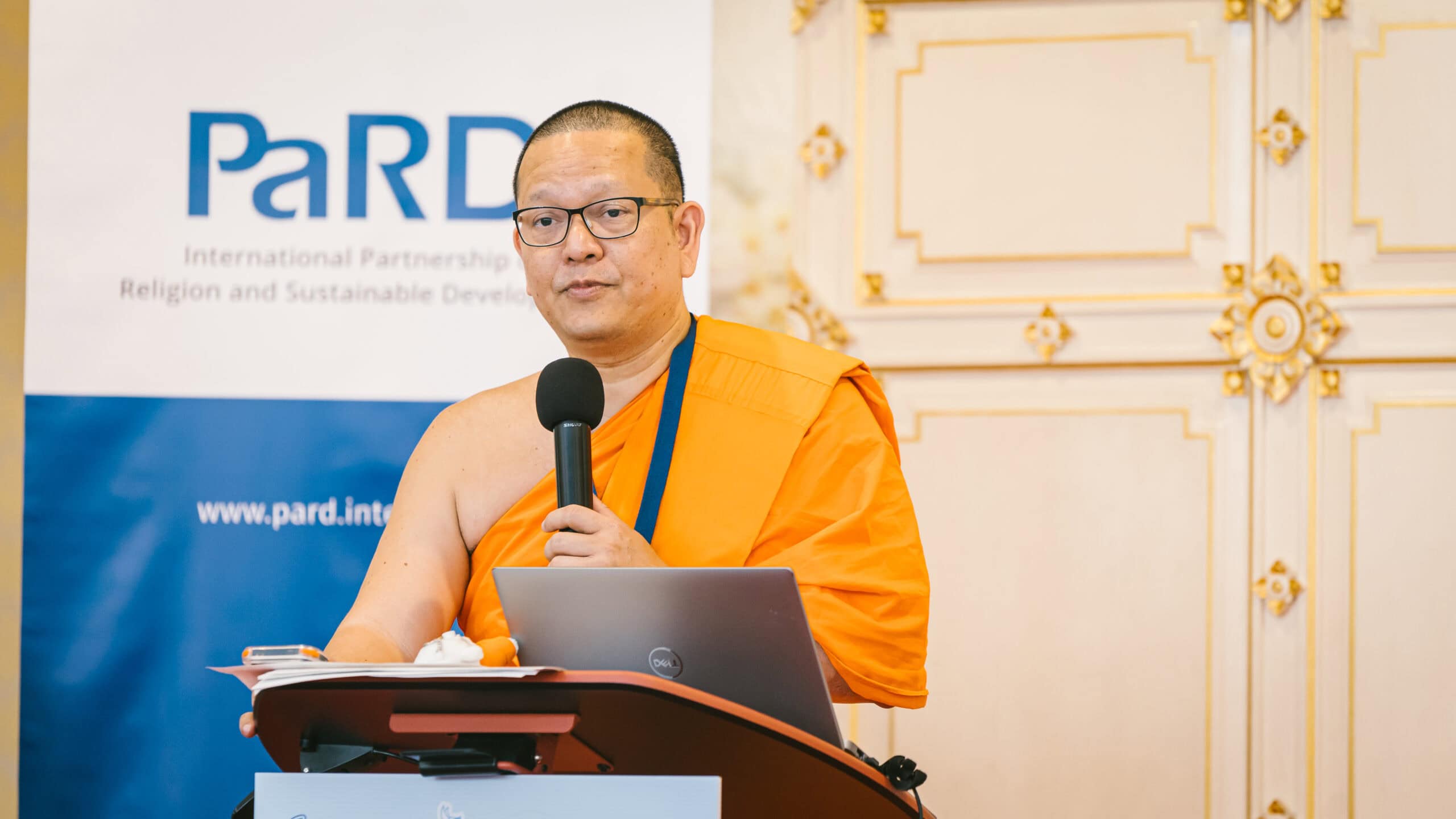
Ambassador Pasquale Ferrara, President of “Reset Dialogues on Civilization” an international think tank that promotes cultural and religious pluralism in different civilizational environments, reflected on the moral and political responsibility of faith actors in advancing climate justice, food security, and sustainable development worldwide.

Your Excellencies,
Distinguished colleagues,
Dear friends,
It is an honor to address the 2025 PaRD Annual Forum here in Istanbul — a city that, for centuries, has connected continents, cultures, and faiths. Earlier this month, near Rome, a major international conference titled “Raising Hope for Climate Justice” marked the tenth anniversary of Laudato Si’, Pope Francis’ landmark Encyclical on Integral Ecology. Organized by the lay Catholic movement Focolari, the event brought together religious leaders, scientists, international institutions, and public officials from across the world.
One of the most unexpected — and memorable — voices at the event was that of Arnold Schwarzenegger: actor, environmental advocate, and former Governor of California. Known for his cinematic legacy, he describes himself on X with a touch of irony: “TV Dad, Bodybuilder, Conan, Terminator, and former Governor of California. I killed the Predator. I told you I’d be back. I’m here to pump you up.” Yet his words in Rome were anything but ironic. Addressing an audience of faith leaders, scientists, and activists, he called the Church “a moral superpower” and warned that “hope without a plan is not a strategy.” He coined the phrase: “Let’s terminate pollution.” Beyond the slogan, Schwarzenegger offered a powerful insight: strength is responsibility. His call to move “from prayer to practice” powerfully captured what this Forum — and what PaRD itself — represents: the transformation of spiritual and ethical conviction into concrete, cooperative action.
The central moral voice of the conference, however, was Pope Leo XIV, who called Laudato Si’ “a constant source of inspiration,” one that continues to energize academic, civic, and interfaith engagement worldwide. He urged the international community — and the forthcoming summits at COP 30, the Committee on World Food Security, and the 2026 UN Water Conference — to “listen to the cry of the Earth and the cry of the poor.” Laudato Si’ remains a cornerstone for global ecological responsibility. It is not only a document of the Catholic Church — it is a charter for a shared future, grounded in justice, sustainability, and solidarity.
Our Moment of Choice
Our world is at a crossroads. Across regions, we are witnessing growing unilateralism, shrinking civic space, and a decline in investment in international cooperation. This marks a degradation of the very essence of international society in favor of a system based increasingly on force and hard power. In this moment of fragmentation, we must turn the tide of this negative cycle. Fostering collaboration among governments, civil society, and faith communities is not optional — it is indispensable. If the Western liberal order is indeed collapsing, then a truly global solidarist order is more necessary than ever.
PaRD embodies the understanding that sustainable development transcends technical and financial challenges, demanding a deeper ethical dimension. By connecting governments and faith-based actors, it creates a unique space where moral conviction and policy responsibility converge in meaningful partnership.
This is not an attempt at “greening” religions, but rather the discovery of an essential and generative focus that faith communities bring to global challenges. This is what PaRD represents: the conviction that faith-inspired action can strengthen the moral and political foundations of global diplomacy. As Laudato Si’ reminds us, “inequity affects not only individuals but entire countries; it compels us to consider an ethics of international relations.” What we need is a comprehensive planetary politics.
The Environmental Turn in Global Affairs
The environmental turn in international relations is not merely a reflection of new challenges, but a conscious attempt to reshape the global agenda. Issues like climate change, biodiversity loss, and hunger are being reframed from peripheral concerns to central pillars of contemporary politics.
The traditional divide between “high politics” (focused on state survival) and “low politics” (focused on human survival) is increasingly being questioned and blurred. This evolving paradigm calls for environmental stewardship — recognizing that the planet’s survival depends on collective responsibility across nations, sectors, and traditions. The ecological question is not just technical; it is fundamentally civilizational.
Food Security as a Measure of Justice
Food security is a true test of our ethical and political maturity. Hunger persists not because food is lacking, but because justice is. Faith-inspired actors show that feeding the world requires inclusive, forward-looking, and equitable governance. Through sustainable agriculture, fair trade, and support for smallholder farmers, they link local solidarity to global accountability. This demonstrates that the micro-foundations of global politics are not a utopian dream — they are already at work. Food is not just a commodity — it is a covenant between people, the Earth, and future generations.
Food and Peace: Lessons from Ukraine and Gaza
The wars in Ukraine and Gaza have exposed the deep link between food and peace. The blockade of Black Sea grain exports disrupted global markets, worsening hunger far from the battlefield. In Gaza, the restriction of food and water turned deprivation into a weapon of war. These tragedies make one truth undeniable: food security and peace are inseparable. As Laudato Si’ teaches, “the environment is closely linked to the human and social dimensions of peace.” Faith-based networks have acted as ethical mediators, calling for humanitarian access and the protection of food delivery — an operation that must never become weaponized. Defending the right to food is defending the foundations of peace.
Interreligious Engagement for Food Security
Across the world, interreligious initiatives are advancing a holistic vision of food security as a core element of human security. Locally, diverse religious communities promote sustainable farming, agroecology, and nutrition programs grounded in ethics of care and non-violence. Globally, networks such as the Faith and Food Coalition, the Interfaith Rainforest Initiative, and the Alliance of Religions and Conservation bring together believers of different faiths to advocate for justice and sustainability.
This movement gained international recognition under the 2024 Italian G7 Presidency. The Capri Communiqué explicitly acknowledged the strategic role of interreligious actors in strengthening food systems, promoting peace, and supporting fragile communities. That recognition was not symbolic. It reflected a genuine shift in international thinking: an understanding that spiritual and moral resources are part of the architecture of global food governance.
Still, interreligious cooperation does not replace state responsibility. Governments hold authority; religious communities hold trust. Together, they can build what Pope Francis calls integral ecology — a synthesis of ethics and policy, solidarity and governance. This partnership is a living expression of environmental stewardship: humanity’s shared duty to safeguard the Earth’s capacity to sustain life.
From Ethics to Policy: The Way Forward
To turn moral vision into political reality, we must act on five fronts:
1. Build Enduring Partnerships Between Governments and Faith Communities Not symbolic inclusion, but shared responsibility in designing and implementing strategies for food security and environmental justice.
2. Support Sustainable Agriculture and Local Resilience Faith-inspired actors, with their grassroots legitimacy, can bridge policy and practice — promoting agroecology, soil regeneration, and fair access to land and water.
3. Develop Ethical Indicators for Food Security Progress must be measured not only in tons or GDP, but in equity, inclusion, and ecological balance. Religious traditions offer frameworks for rethinking what genuine progress means.
4. Educate for an Integral Ecology Academic and religious institutions should co-create educational programs linking ethics, food, and climate. Interfaith education can form leaders who unite moral imagination with scientific and political competence.
5. Affirm the Climate–Food–Peace Nexus Future COP and CFS meetings must explicitly address the links between hunger, conflict, and environmental degradation — recognizing the unique role of religion in mediation, mobilization, and cooperation.
Conclusion: From Hope to Shared Responsibility
Dear friends,
Our century demands more than optimism — it demands moral courage. The challenge is not only to feed humanity, but to redefine how humanity lives on Earth. Laudato Si’ calls this an ecological conversion. I would call it a conversion to responsibility — the recognition that the planet is not our possession, but our partner. Perhaps Schwarzenegger put it best: “Let’s terminate pollution.” But we might add: let’s also terminate indifference, fragmentation, and despair. If hope without a plan is not a strategy, then hope with commitment is the beginning of justice.
Thank you.